Did Civil Action Die?
Protests across the US and Europe are still happening, sometimes enormous ones. There are marches on women’s rights, climate, immigration, democracy, Gaza, austerity, racism and any number of other causes. The horrors in Gaza ignited ardent campus and campus-adjacent protests that were then met with expulsions and suspensions, police clearances, arrests and government pressure. Millions of Americans have marched against the Trump administration. Europeans have repeatedly taken to the streets over pensions, climate policy, immigration, Palestine and the cost of living. So perhaps the question is not why civil action died. It is why so much civil action seems to accomplish so little.
Too much of it now functions as spectacle without leverage. We march, chant, photograph ourselves, post the photographs, watch clips of confrontations, argue about them online and then go home. The event becomes content. Its online corollaries—the rapid memes that mimic, lampoon and joust around hot-button topics—can certainly elicit some response, however tepid, from politicians, executives, universities and bankers. But these entrenched institutions have learned how to weather the electronic storm: issue a statement, sacrifice somebody sufficiently junior, establish a commission, announce a review, wait forty-eight hours for the algorithm to move on, or simply flood the channels with their own counter-muck. We have become remarkably good at generating attention and remarkably bad at converting attention into power.
Erica Chenoweth’s research on civil resistance suggests that this is not simply nostalgia. Her long-term data reveal an extraordinary paradox. Nonviolent civil resistance became more common during the 2010s than at any previous point in the period she studied, yet its success rate fell sharply. Before 2010, nonviolent campaigns generally succeeded more than 40 per cent of the time and in some decades considerably more; since 2010, fewer than 34 per cent have succeeded. Nonviolent resistance still dramatically outperforms violent rebellion, but modern movements increasingly suffer from weak organisation, overreliance on demonstrations and digital mobilisation, insufficient strategic planning, and an inability to sustain unity when governments respond. Successful movements historically did much more than march. They organised strikes, boycotts and non-cooperation. They built alliances across social groups. They disrupted the economic and institutional systems rulers depended on. They induced businesses, civil servants, churches, unions, security forces, and other pillars of power to withdraw cooperation.
That distinction matters. A million people marching through a capital is an extraordinary image. A million people organised to collectively withhold labour, money, votes, legitimacy, expertise, and cooperation is an extraordinary political force. We have confused visibility with power.
This is particularly disheartening because we face a collection of problems that will shape human life not merely through the next election cycles but through the next century. Climate change will alter where people can live, what food costs, which cities flood and where hundreds of millions of people eventually move. Artificial intelligence will reorganise labour, knowledge, education, warfare and perhaps the distribution of wealth and political power itself. Ageing populations will strain health, pension, and care systems while younger generations are asked to finance institutions designed around demographic conditions that no longer exist. Housing has become unaffordable for younger people across many prosperous societies. Wealth is increasingly concentrated while economic security becomes less certain. Mass migration will intensify as climate, conflict, inequality and demographic imbalance intersect. Biodiversity loss, water scarcity, and ecological degradation will continue largely irrespective of election schedules. Nuclear weapons remain capable of making most other policy debates irrelevant in an afternoon.
Mass protest alone cannot solve these problems. Twelve million people marching through Washington cannot design an electricity grid, devise an AI-safety regime, or determine the optimal pension age. But mass civic action can do what experts, bureaucracies, and markets cannot do alone. Civic action can force change when these narrowly interested institutional constituencies cannot. It can make delay expensive. It can turn an obscure technical question into a public demand. It can force politicians to confront costs they would prefer to push onto people with little voice, or to push further down the road. It can provide political cover for leaders willing to make difficult decisions. And, when coupled with organisation rather than merely demonstration, it can alter the networks of cooperation upon which entrenched power depends. The anti-apartheid movement became formidable not because the world knew apartheid was unjust but because strikes, boycotts, international sanctions, and shifting business interests progressively made its continuation more difficult. The American civil-rights movement did not simply reveal injustice; it organised people to make maintaining that injustice politically, economically, and morally costly.
I have almost zero hope that the current lot of leaders, across the spectrum, possess anything near the courage, conviction and long-term vision required to address our present problems in ways that maximise opportunities for the greatest number while minimising the pain headed towards the most vulnerable. But perhaps even that puts too much blame on individual politicians. We have constructed institutions that reward short-term behaviour and are then surprised when they produce short-term leaders. Politicians operate inside two-, four- and five-year electoral cycles. Governments retreat when petrol prices rise, farmers block roads, homeowners fear falling property values, or some narrow but electorally important constituency threatens revolt. Corporate executives answer to earnings expectations. Media organisations answer to attention. Activist organisations answer to funders and members. Everyone can explain why the sacrifice necessary for the next thirty years must not occur during their particular three-year tenure.
The result is a politics of mini-constituencies. Climate transition is essential until somebody must pay more for electricity. Housing is a crisis until somebody proposes building apartments next door. Government debt is unsustainable until taxes rise or benefits fall. Immigration must be controlled, except where employers need inexpensive workers; immigration must be humane, except where accommodating newcomers requires actual money, schools, and housing. Everybody favours the future in principle while defending their small piece of the present.
And our leaders have become bloated by their own braggadocio to the point where many appear to believe their own bullshit. Everything is historic, transformative, unprecedented, catastrophic, the greatest ever attempted or the worst ever inflicted. A modest programme becomes a revolution. A policy adjustment becomes national salvation. An election victory becomes a mandate for everything the winner has ever believed. A setback is never evidence that an idea might have been wrong; it is sabotage by enemies, misinformation, obstruction, bias or betrayal. The language differs across political tribes, but the underlying pathology is strikingly similar: certainty is rewarded while doubt looks weak.
When was the last time we heard a major political leader say: We were wrong. The evidence changed. Our opponents were right about this part. We do not yet know the answer. This will probably take twenty years, and some of the people voting for me will have to give something up? Humility and grace have become almost maladaptive political traits. They do not generate clips. They do not dominate a debate stage. They do not rally the faithful. Yet they may be precisely the qualities required to govern societies facing problems whose solutions are uncertain, distributed across decades and full of genuine trade-offs.
So we need the masses—not because ordinary people are inherently wiser or more virtuous than elites. They plainly are not. Crowds can be stupid, vicious and spectacularly wrong. Popular movements have produced emancipation and pogroms, democracy and fascism. Romanticising “the people” simply substitutes one fantasy of infallibility for another.
What ordinary people possess is something more mundane and perhaps more valuable: situated knowledge. The parent trying to get two children to school while starting a shift at eight knows something about transport and childcare that the ministry seemingly does not. The nurse finishing a twelve-hour shift knows where the hospital system wastes time in ways its executives cannot see from a spreadsheet. The teacher knows why a child stops coming to school before the attendance statistics reveal a trend. The shopkeeper knows what happens to a neighbourhood when rents double. The immigrant knows where an apparently rational administrative system becomes incomprehensible to the person expected to navigate it. The carpenter, farmer, truck driver, software engineer, social worker and small-business owner each live inside systems that policymakers generally encounter as categories of data.
None of those people individually knows enough. Together, however, they possess a distributed understanding of society that no cabinet, university, consultancy or artificial intelligence can reproduce from above. Democracy at its best is not based on the sentimental proposition that “the people are wise.” It is based on the harder proposition that no governing system can become wise while systematically excluding the knowledge of the people who live inside it.
But we have increasingly replaced that kind of participation with political fandom. We wear politics like team colours. We cheer when our side humiliates theirs. We excuse conduct from our own politicians that would enrage us if the opposition did exactly the same thing. We repost the spectacular dunk, watch the debate to see who “won”, follow polling averages as though checking league standings and experience an election victory as emotional vindication rather than as the beginning of an obligation to govern.
Considerable research supports this phenomenon. Political scientists describe “affective polarisation”: partisanship functioning not simply as a collection of policy preferences but as a social identity through which people increasingly distrust and dislike members of the opposing political camp. That transforms politics from What should we do? into Who are you with? Once that happens, political participation itself can become curiously passive. Supporting the team feels like participation even if all we actually do is consume its media, repeat its arguments and periodically vote for its players.
The irony is that enormous mobilisation can coexist with extraordinarily weak civic organisation. Liz McKenna’s August 2026 research followed 38,740 people taking civic action beyond voting through organisations in eleven US states. Seventy-one per cent participated once and did not return during the year studied. Among people whose first participation was a mass mobilisation, attrition approached 90 per cent. But organisations that embedded people in actual teams—where somebody knew their name, expected them back and gave them continuing responsibility—retained participants substantially better.
In another study published the same month, McKenna examined Brazil’s enormous 2013–16 protest cycle and compared loosely organised digital movements with movements rooted in unions and membership organisations. The critical difference was not simply how many people appeared in the streets. Groups that invested in membership structures were far better able to convert mobilisation into durable political influence. McKenna calls one of the failures she observed “means–ends decoupling”: activity continues and multiplies even though the capacities necessary to accomplish the ostensible objective are not being built. Digital technology makes that especially easy. We can organise the appearance of collective action without constructing the organisation underneath it.
Perhaps that is where civil action actually died.
Not in the street.
Not even on the screen.
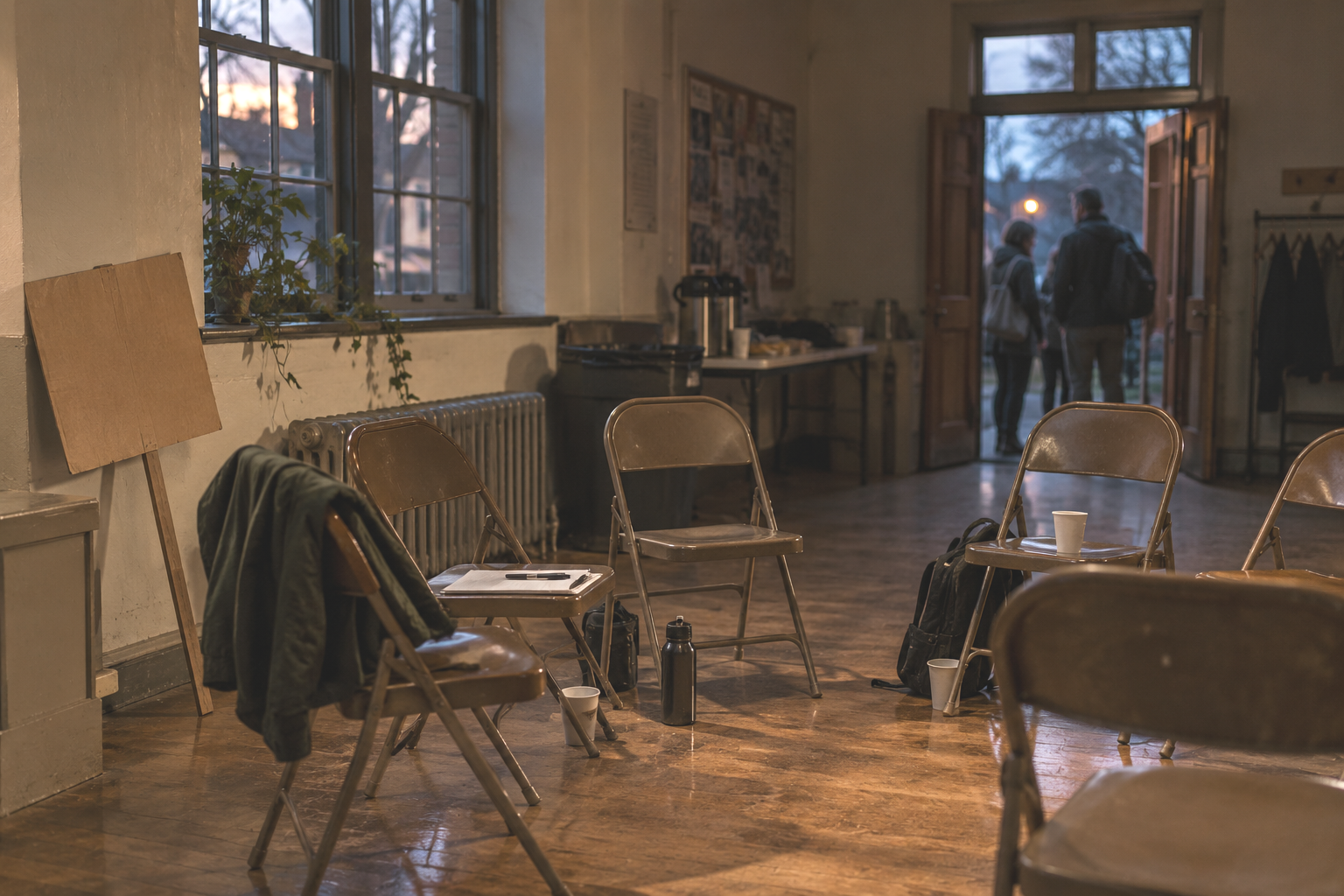
It died somewhere between the march and the next meeting.
We need to stop teaming up with the bastards up top and start reaching out to the people we actually know across the spectrum. We need to tap out from the online slurry and get in touch with one another. Not through another national organisation asking for our email address and a $15 recurring contribution. Not by liking somebody’s declaration of solidarity. In physical places. Repeatedly. Neighbourhood groups. Unions. Parent associations. Churches, mosques, and synagogues. Sports clubs. Professional organisations. Volunteer fire departments. Community gardens. Tenant associations. Local newspapers. Reading groups. Town councils. The innumerable imperfect institutions in which people learn the difficult art of doing something with other human beings.
The requirement sounds embarrassingly small compared with “saving democracy”: know ten people. Meet them again. Know the person who disagrees with you. Find one problem you share. Work on it. Learn who controls the decision. Understand the rules. Bring in another twenty people. Divide the labour. Raise some money. Keep records. Give newcomers something useful to do. Elect somebody competent to run the meeting. Replace them when they become an asshole. Come back next month.
That is organisation.
And organisation accumulates. It creates relationships, knowledge, trust, obligation, institutional memory and eventually leverage. The demonstration then becomes not the movement itself but one instrument available to a movement that already exists.
Power probably likes our present version of activism much more than we imagine. It can withstand our indignation. It can wait out our trending hashtags. It can watch a million people march past the windows and calculate that most of them will be home by dinner and that nine out of ten newcomers may never appear again. What it has considerably more difficulty with is people who keep coming back.
So fuck the politicians. Fuck the celebrities. Fuck the influencers. Fuck the fantasy that somebody sufficiently brilliant, charismatic, or righteous is eventually going to descend from above and fix this for us.
It is time to take back what belongs to all of us.
But “taking it back” cannot itself become another slogan.
Who runs the meeting Tuesday night?
Who calls the fifty people who came last time and asks why they did not return?
Who learns the zoning rules?
Who talks to the union?
Who raises the money?
Who knocks on the door of the neighbour whose politics they cannot stand?
Who is still there six months later, after the cameras are gone and nobody is paying attention?
Perhaps civil action did not die because we stopped caring.
Perhaps it died because we stopped building the things that allow caring people to become powerful together.


